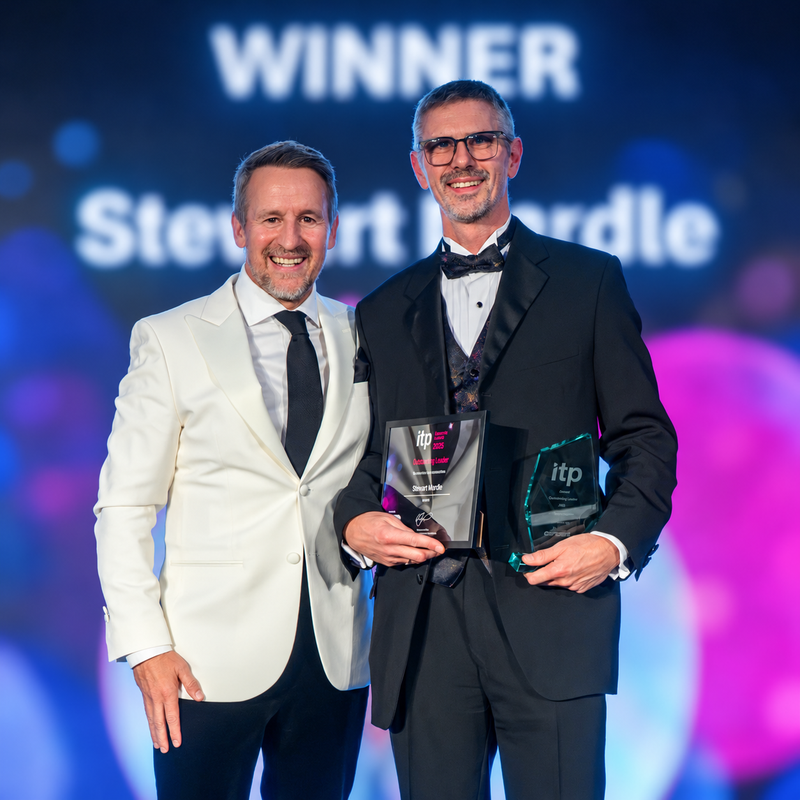
Meet the ITP’s 2026 Outstanding Leader Winner – Stewart Mardle FITP, Senior Manager, Group Health and Safety, BT Group and Director at Mast and Tower Safety (MATS) Group
1. Congratulations on winning the Outstanding Leader Award! What first motivated you to get involved with the Mast and Tower Safety (MATS) Group, and what does its mission mean to you personally?
Thank you. It is a real honour, and a slightly strange one, because so much of what I am being recognised for was done with other people.
I have worked in telecoms for more than 37 years, most of that time in health and safety at BT, and a large part of it has been about work at height. I joined MATS in 2011, taking over from my predecessor when they retired, and it quickly became more than just part of the job. I chaired the group from 2019 to 2021, which took us through COVID, and I have been a director since 2023. Along the way I helped write the EUSR tower climbing and rescue course, and I wrote the rooftop worker safety and access course in consultation with the industry. Between them, those two schemes are now the backbone of training in the sector.
What drew me to MATS was that it brings together operators, infrastructure owners and contractors, organisations that compete with each other every day, and gets them to agree on how to keep people safe. No single company can raise standards across a whole sector on its own.
Personally, the mission comes down to the person at the base of the structure. Everything we publish eventually reaches someone clipping on to climb a mast or stepping out onto a rooftop. If our work helps them get home safely at the end of the day, it is worth all of the hours that we all put in.
2. You recognised that MATS’s ambitions were outgrowing its volunteer-led structure. Was there a particular moment that convinced you things needed to change?
It was less a single moment and more a growing realisation that our ambition had overtaken our structure. MATS began with 17 founding member organisations, run entirely by volunteers alongside full-time jobs. Progress relied on a handful of proactive individuals, important pieces of work, including our technical guidance, were struggling to move forward, and decision-making sat largely with health and safety specialists like me rather than with the people carrying out the high-risk work itself.
That last point bothered me most. For an organisation whose whole purpose is the safety of people working at height, they were not close enough to the decisions.
Rather than just asking everyone to try harder, I stepped back and analysed the pressures on MATS and the industry it serves, partly through my leadership studies. That made it clear the issue was not effort or commitment. It was structure. That analysis became the case for associate membership and subgroups.
3. Bringing people with you can be the hardest part of changing an organisation. What was the most challenging conversation during the transformation, and how did you move it forward?
The hardest conversations were not about the mechanics of the change. They were with people who cared deeply about MATS and wanted to protect what had already been built. Introducing associate membership and subgroups meant rethinking how influence and responsibility were shared, and that is a big thing to ask of people who have given years of their own time to an organisation.
My approach was to create space for challenge rather than try to win an argument. I led the discussions with the directors and members myself, shared the vision openly and made it clear that it was not finished. People needed to feel safe to disagree and to put forward their own ideas. Where the challenge was right, I changed the proposal.
That made the difference. Once people could see their concerns reflected in the design, the conversation moved from whether we should change to how we would make it work, and the model we ended up with had genuine buy-in rather than reluctant acceptance.
4. You’ve spoken about creating space for members to challenge your proposals. Can you share an example of feedback that changed your thinking and made the final approach stronger?
The most useful challenge was that creating subgroups would not, on its own, solve the problem. More people and more activity do not automatically mean more delivery. Directors rightly asked how the subgroups would be governed, how they would report back and how we would keep them focused on MATS priorities rather than drifting.
They were right, and it shifted my focus from simply creating capacity to creating capacity with accountability. We are now putting that into practice with subgroup charters, a delivery framework and clearer reporting, so that everyone knows what they own and how it fits the bigger picture.
It is a good example of something I keep relearning: if people feel a proposal is already decided, they either stay quiet or resist it. When they can see it is still open, they improve it, and the result is stronger than anything I would have designed on my own.
5. One of your priorities was giving those carrying out high-risk work a greater voice in decisions. What can leaders learn by listening directly to the people doing the work, and how are you putting that into practice at MATS?
Leaders learn the difference between how work is imagined and how it is actually done. Procedures are written at a desk; climbing happens in wind and rain, against a deadline, sometimes on a structure that does not quite match the drawings. The people doing the work know where the gaps are, and if you do not ask them, you end up writing guidance that is correct on paper and ignored in practice.
At MATS we are building that voice into the structure rather than relying on goodwill. Associate membership brings in contractors and training providers who are much closer to the work. Subgroups give them a direct hand in shaping guidance. Our consultation with Energy & Utility Skills asked training providers and members how competence is recorded in practice. Their concerns about cost, admin burden and data protection changed the recommendation: rather than pushing ahead with a central system, we will test the idea more widely first. And at this year’s conference we are running live questions and polls, so delegates can shape the discussion in the room rather than just listen to it.
6. In a volunteer organisation, people are contributing alongside demanding day jobs. How do you keep them engaged and turn enthusiasm into progress without asking too much of them?
I start by respecting that their time is a gift, not an entitlement. Everyone involved in MATS has a full-time job, and the quickest way to lose good volunteers is to give them vague, open-ended tasks that never seem to finish.
So we try to make contributions well-defined and achievable: a clear piece of work, a realistic timescale, and someone accountable for pulling it together. Subgroups help because they spread the load. Instead of five people trying to do everything, more people each own one piece of it. Good administrative support matters too, so volunteers spend their time on the expertise only they can bring rather than on chasing diaries.
The other part is recognition. When a piece of guidance is published or the conference comes together, I make sure the people who did the work are seen. Enthusiasm lasts much longer when people can see it is making a difference.
7. Introducing associate membership and subgroups has brought more people into MATS’s work. When did you first see someone take ownership of an initiative in a way that showed the new structure was working?
The clearest example was the nesting birds guidance. The issue did not come from the directors. It came from a member dealing with a real operational problem: during the nesting season, structures were effectively becoming out of bounds, which made it difficult to maintain the network. That member made the initial contact with the RSPB themselves.
MATS then took the work forward on behalf of the whole industry, and it gathered momentum because people with the right expertise stepped forward and contributed. Under the old way of working, an idea like that would have sat on a director’s to-do list waiting for capacity. Instead, it became GN021, published in April 2026.
That was a powerful moment for me. It showed the organisation was starting to generate solutions through its wider community rather than relying on a handful of directors. Growing to 32 associates in under a year is a good number, but seeing people take the lead without being directed is what told me the structure was working.
8. MATS has released new guidance on nesting birds and is preparing for its biggest conference yet. Which achievement best captures the difference the changes have made and why?
Both matter, but if I had to choose one it would be the conference, because it shows the change at the scale of the whole industry.
Our 2025 conference was our biggest to date, and this year we have had to move to a larger venue to cope with demand. We are expecting around 400 delegates at Cranmore Park in Solihull on 25 November. The growth in associates and sponsors, and the range of organisations taking part, simply would not have been possible under the old structure, when a few volunteers organised everything.
The theme, Weathering Change: People and Infrastructure Under Pressure, also reflects where we have tried to take MATS. It puts people at the centre, not just the assets. And we are using live questions and polls on the day so delegates can shape the discussion rather than just listen to it. For me that captures the change in one place: a bigger MATS, and one that gives a louder voice to the people doing the work.
9. Membership and visibility have grown, but the purpose remains improving safety. How do you judge whether a stronger MATS is making a practical difference to people working on masts and towers?
That is the right question to ask, and I try to ask it of myself regularly. Growth is only useful if it turns into safer work.
The honest answer is that in safety it is hard to measure what did not happen. So I look at several things together. Reach is one: the training schemes MATS backs have now reached more than 15,000 people across tower climbing and rescue and rooftop safety, and our guidance is freely available to organisations well beyond our membership. Relevance is another: are we tackling the problems people actually face on site? The nesting birds guidance exists because teams were struggling to balance network maintenance, wildlife law and safe work at height, and it gives planners and climbers a structured way through that.
The third, and the most important, is what we hear from the people doing the work. When a climber or a site supervisor tells us a piece of guidance changed how they planned a job, that matters more to me than any membership figure.
10. You describe leadership as something to be done properly, rather than simply quickly. What has this experience taught you about when to step back and when to act and what advice would you give someone leading change with limited resources?
It has taught me that speed and progress are not the same thing. In a resource-constrained organisation, the temptation is to firefight: fix whatever is most visible and move on. That feels productive, but often you are treating symptoms and burning out the same few people in the process.
I step back when the same problem keeps coming back, because that usually means the cause is structural. I act quickly when people are at risk, or when the way forward is clear and waiting only costs goodwill. Once there is agreement, momentum matters, and dragging out implementation can undo the trust you have built.
My advice for anyone leading change with limited resources: diagnose before you prescribe. Bring people into the problem, not just the solution. Be honest about capacity and do fewer things well. And share the credit generously, because in a volunteer organisation that is often the only reward you can give.
11. What does winning this award mean to you, and what would you most like MATS to achieve next?
It means a great deal, particularly after 37 years in this industry. But I see it as recognition of what MATS has become, and that belongs to the directors, members, associates and volunteers who gave their time to make it happen. I am accepting it on their behalf as much as my own.
My ambition is for MATS to be the recognised industry body for safety on telecoms infrastructure: the first place operators, contractors and regulators turn to when they need a standard, a view or a voice from the people doing the work. We are already working towards that. We have refreshed our purpose and mission, and we are engaging with boards, chief executives and the HSE, not just safety practitioners, because being recognised means being heard where decisions are made.
Alongside that, I want us to keep building the guidance library, take forward the findings from our climbing industry consultation on how competence is recorded, and keep growing the voice of the workforce in everything we decide. Our conference on 25 November is a good moment to start that next chapter with the industry in the room.